Monday, June 25, 2012

Simple electric generators and motors


Above example of wire between 2 magnets could be used to make simpler direct current (DC) generator or DC motor. It should be easy enough to teach 10 year old kids in poorest countries how to build simple motors within hour. Batteries are source of DC.
Like seen on above image wires are close but not touching.
Alternating current (AC) using motors and generators can be similar but with extra complexity designed to rotate parts of it right amount before current changes direction so inertia would not be lost.

Reason how same design can work as generator and engine is that charged particles behave according to right hand rule. According to that if charged particle moves perpendicular to magnetic field lines (B) between south and north pole then magnetic field forces charged particles to move circularly in direction that is at 90 angle with present direction of current.
For example electron beam above keeps rotating in magnetic field with consistent radius. This effect is also used in particle accelerator sensors to see what charges did the new seen particles have as they know direction of magnetic field and which charge should rotate which way.
If charged particle moves perpendicular to magnetic field lines then they will always spiral or move circularly. Positive charge would be forced to move in direction F on above image and electron would turn to opposite side but if charge doesn't move in relation to magnet then they have no effect on each other.
These 3 directions B, v and F are at 90 degree angle with other 2 directions.


These 3 directions have been described with Fleming's left hand and right hand rule although they show same basic thing in different situations. Left hand example is used to describe generators and right hand example to illustrate engines. In left hand example if current flows in direction  shown compared to magnetic field direction then entire wire would be pulled somewhat sideways (thrust of motion). In motor charges moved because electricity flowed but in generator this movement can be cause by moving wire or any electric conductor through magnetic field and charged particles would start to move but in generators wire is oriented so force makes charged particles move in wire not push wire sideways because charges couldn't exit wire through insulation. For example if wire is held parallel to direction F in third hand rule illustration and moved horizontally up towards v then magnetic field forces current to move in direction F. In motor if wire is vertical with direction v then letting current flow in that direction would force entire wire towards direction F if positive charge moved there but wire would be forced to opposite direction if electron moved towards direction v.   


In above image arrows show direction of electron movements. Using bent wire that goes both ways allows different parts of wires to be forced in opposite directions keeping entire wire moving circularly. 
Tips of wires are connected to different pieces of split rings. Carbon brushes transmit electricity to split ring and wire that connects its sides but because the gap of split-ring may lose connection with brushes every 180 degree turn so voltage can go near zero twice per turn. 
In AC generator and motor these rings get used bit differently. Here different tips of bent wires get connected to different rings which change polarity regularly so generator or motor could keep turning the same way. Such motors should have stable AC frequency dependent rotating speeds while DC motors may be able to rotate with almost any speed that their strength and air resistance would allow.

Alternator is generator for alternating current. It doesn't matter much if magnets do the moving or wires as long conductors change location in magnetic field. Alternator causes electricity by using same physics phenomena but due to magnetic field reversing during this movement the current it produces is also reversed about as often as it takes for a 180 degree turn for magnet. As main bonus AC can be transported up to hundreds of kilometers with little loss in power and AC is required for radio waves with radio waves having same frequency as AC that flowed in antenna. High frequency radio waves needed to transmit TV channels and radio can't use a magnet rotating over 100 million times per second but electronically such AC frequencies can me made without moving parts using logic gates and central clock.  

Thursday, April 26, 2012

Mass spectrometry

For those wondering how people could find out from what element something is made out of, knowing how mass spectrometry (MS) works could be the answer.

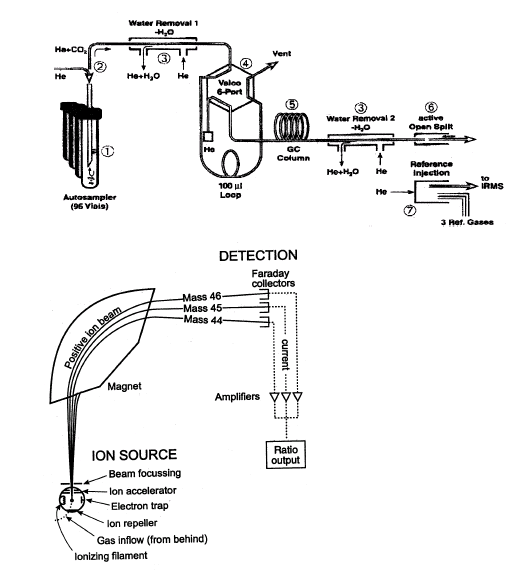
(image from here) Above illustration gives general idea about MS.
1) first sample is vaporised and electrically charged with electron beam. Depending on beams energy molecules could be broken into smaller molecules or in more energetic extreme every atom may be separated from each other.
2) electron beam removes electron giving atoms positive charge (all elements get positive charge with powerful enough electron beam). Positively charged electrode will capture electrons and push away positive ions.
3) moving ions reach magnetic field with magnetic field line perpendicular to ion trajectory. If a charged particle moves through magnetic field like that it will start to turn depending on pole positions and charge of particle. To achieve turn like in upper example with positive ions magnetic southern pole should be towards viewer and north pole on the other side of image.
4) more charged and lighter ions turn more and more massive ions turn less. Massive ions also take much more time to reach sensors. This technique also recognizes other isotopes because different neutron number affects the mass but not charge.
One co-inventor of MS was Joseph John Thompson (Nobel Prize winner for discovering electrons) who was also credited with discovering isotopes. 
5) In the end ions could be photographed. In primitive versions simple photo plates were used. They react to visible light but also to charged energetic particles. Today semiconductor sensors similar to the ones used in digital cameras could be used to sense where the ions moved and turn it into a electric signal for monitor. 
One of the earliest MS photos (source) showing the discovery of different neon isotopes.

Calutron device was basically a mass spectrometer made for isotope separation for nuclear weapons. First large version was good enough to enrich uranium to 15% of U235. It was very energy consuming and got later replaced with cheaper and more productive methods.

Like typical MS it vaporized uranium with electron beam, accelerated it away from heat and magnetic field made ions turn in predictable way. Lighter U235 isotopes turned faster in magnetic field and reached collecting vessel while heavier U238 missed the vessel and got removed.

How MRI and nuclear magnetic resonance (NMR) spectroscopy works

NMR is measured as radio frequency EM radiation from nuclei with odd number of protons and/or neutrons when they have been stimulated by similar frequency radio waves from some outside source so basically echoing radio waves. Such nuclei produce frequencies linearly dependent on how strong is the magnetic field on atoms. For example a 1 tesla magnetic field creates X frequency but 2 teslas produce 2 times higher frequency. If that nucleus has connection with other atoms its NMR frequency is altered by usually few parts in million. Normally in magnetic field of Earth hydrogen echos ~10 000-20 000 Hz radio waves but several Teslas strong fields can echo close to thousand megahertz or more which can make it easier to check 1 in million frequency changes to find molecular structure with radio waves without destroying the sample. In fMRIs for example they are commonly used to check where is oxygen used by the amount of hemoglobin without oxygen (with oxygen hemoglobin is nonmagnetic but without it it becomes magnetic so metabolism speed alters how much body part reflects/echos radio waves). Using several tesla NMR detectors could In everyday life hydrogen itself or radioactive isotopes of other elements show up in NMR. 

In NMR spectroscopy you could use NMR to possibly find out from what chemical bonds some sample has by measuring mostly hydrogen signal. For example carbohydrate (with organic samples hydrogen atoms are usually main element that absorbs and echos radio waves) sample is put in a evenly strong magnetic field and many different radio frequencies are sent through it. Nuclei are sensitive to certain frequency in given magnetic field and after stopping artificial radio waves the same antenna could be used to measure radio waves from sample atoms for up to few seconds afterwards.
These measured waves are bit different depending if hydrogen is attached to other atom but to measure 1 in million differences strong magnetic field may be needed because the magnetic field of Earth gives hydrogen about 10 000-20 000 Hz radio frequency that is almost useless for measuring frequency changes around 1 in million.


MRI scanners measure almost only the hydrogen in body because almost all O, N an C has even number of nucleons (protons/neutrons) and don't have NMR signals. MRI (image source link) still uses NMR but with antennas from many angles.

Above image illustrates magnetic fields turned on from different sides. Different body areas get different magnetic field strength and therefore emit different radio frequencies (after absorbing same radio frequency). For example if you put your fingers near a magnet with different fingers at different distances from magnet then the MRI antenna should find 5 different frequency peaks for each finger (plus some broad signal range for rest of palm) but if fingers are in equal distance and in equal magnetic fields then only one peak may be visible. The emitted different radio frequencies are not absorbed by body and exit body to partly reach antennas. MRI machine tries out different angles for body and every time it calculates about how far from magnet was the hydrogen rich or poor area.
With stronger magnets it becomes easier to see tinier differences in hydrogen density.

Introduction


Unless I find other uses for this part I'll keep it short by saying from where I learned about these operating mechanisms- almost entirely from 2 pages:
wikipedia and http://hyperphysics.phy-astr.gsu.edu/hbase/hframe.html